Optimization for the Agentic Web
From Ranking to Authority
The traditional goal of SEO was to “rank”—to appear at the top of a list of blue links. In the agentic web, the goal is “authority”—to be the source of truth that an agent cites when answering a query.
Our strategy with Humanship has shifted from keyword targeting to Definitional Authority. We aren’t just writing about concepts; we are formalizing them in a way that both humans and machines can’t ignore.
The Three-Layer Optimization
We’ve applied a layered approach to ensure the corpus is discoverable and intelligible across all interfaces:
1. SEO (Search Engine Optimization)
For the Human Crawler.
Beyond meta titles, we use JSON-LD Schema (DefinedTermSet) to tell search engines exactly what our core concepts are. We don’t just hope they understand “Private Rehearsal”—we define it as a semantic entity.
- Performance: Our Largest Contentful Paint (LCP) sits at 94% “Good”, ensuring humans aren’t kept waiting.
2. AEO (AI Engine Optimization)
For the Large Language Model.
Agents need a clear entrance to the “brain” of a site. By providing a structured llms.txt, we offer a machine-readable summary of our mission.
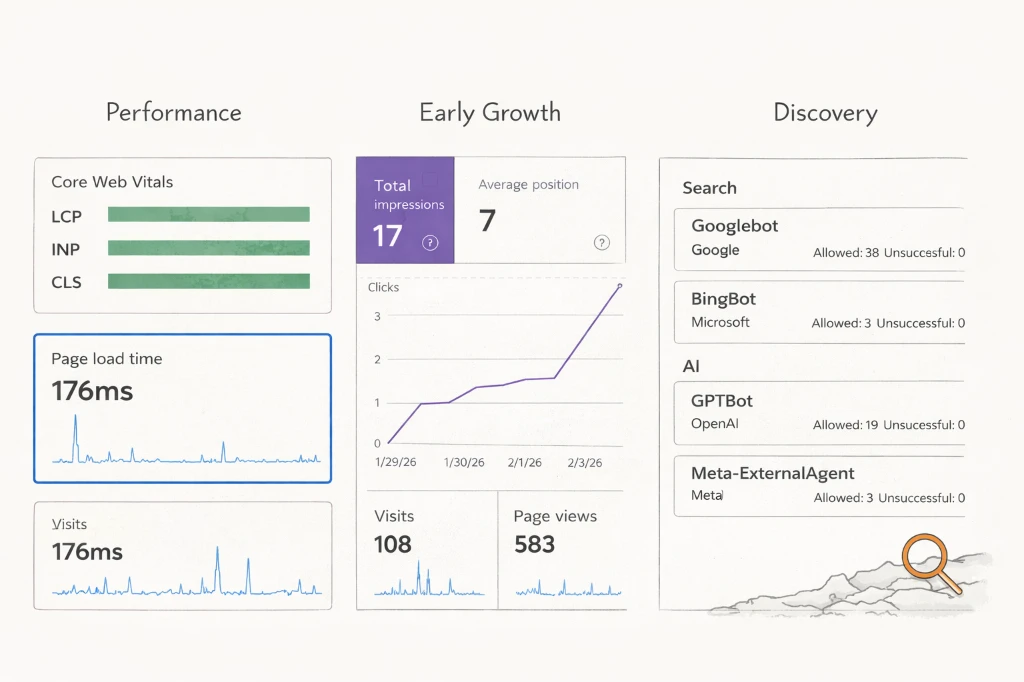
- Reflection on Presence: Recent analytics show that GPTBot (OpenAI) and Meta-ExternalAgent are already active.
3. GEO (Generative Engine Optimization) For the RAG (Retrieval-Augmented Generation) Piper. GEO is about the health and “intelligibility” of the content. We use Core Web Vitals (CWV) as a proxy for technical authority.
- Stability: Our Cumulative Layout Shift (CLS) is 100% “Good”, meaning the content doesn’t jump as it’s parsed.
- Reach: With 1.45k unique visitors last week, the corpus is actively being cited.
Critical Data Reflection
High Ground vs. High Velocity
Building a corpus is a quantitative race as much as a qualitative one.
The Quantitative Signal
Even in its infancy, the corpus is generating a “Ghost Signal” in traditional search. 17 impressions and a #7 average position (likely brand-specific) indicate that the technical path is clear. While these numbers are small, they represent High Velocity for a brand-new domain.
The Authority Gap
The most critical realization comes from the current state of AI Overviews.
As of today, when a user asks about “Humanship,” the AI results cite Walmart, Amazon, and Spotify. These entities don’t own the philosophy of Natural Leadership—they own the Distribution. This is the Authority Gap.
The AI is pulling from where the commercial signal is strongest, not where the definitional signal is deepest. Our strategy of Definitional Authority (via DefinedTerm schema and llms.txt) is designed specifically to bridge this gap—to force the citation back to the source.
Reflection: The Mountain of Noise
The web is increasingly filled with low-quality, AI-generated noise—what we call “The Mountain.” To stand apart, we build “The Signal.”
By combining Sophisticated Minimalism with Deep Structure, we ensure that when an agent (or a human) looks at Humanship, they find a corpus that is intentionally designed to be understood.
We aren’t just publishing notes; we are practicing Intentional Presence in the digital architecture.