
Why Does It Take Monks?
Today, my wife and I stood in a parking lot in Chester, Virginia, waiting for Buddhist monks to walk past us.
There were no signs.
No chants.
No instructions.
Just people.
And then monks. Walking.
What surprised me most wasn’t the monks.
It was the crowd.
The conditions mattered
Hundreds of people gathered on a bitterly cold day, navigating icy conditions, just to be present. Some held phones. Some held flowers. Others stood quietly, hands folded.
No pushing.
No rushing.
No visible frustration.
No one told us how to behave.
The conditions invited it.
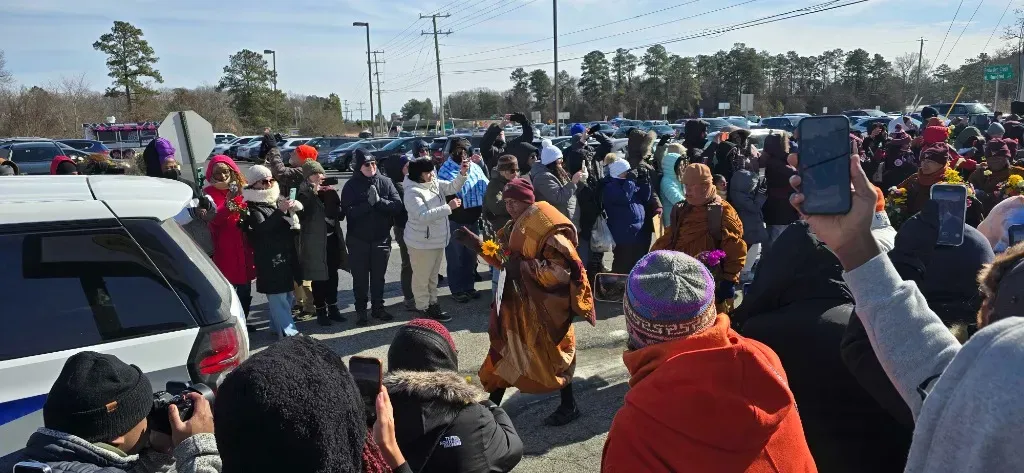 A crowd gathers in Chester, Virginia to witness the peace walk.
This wasn’t about being “better”
Nothing about this moment suggested that other events or forms of expression are less meaningful or less peaceful.
Watching from home matters.
Engaging quietly matters.
Engaging differently matters.
What stood out here wasn’t how people participated.
It was that so many chose to show up together, in person, without being asked.
They left their screens behind, not because screens are bad, but because presence felt possible.
The moment didn’t demand anything
The monks didn’t ask us to believe.
They didn’t ask us to agree.
They didn’t ask us to act.
They didn’t even ask for attention.
They just walked.
And that was enough to shape how everyone else showed up.
We didn’t change. Access did.
People didn’t suddenly become patient.
They didn’t suddenly become respectful.
They didn’t suddenly learn how to coexist.
They already knew how.
The environment simply made those qualities easier to reach.
There was no competition.
No performance.
No urgency to react.
For a moment, no one was trying to win.
So no one acted like they had to.
The question that stayed with me
Why does it take something like this to create those conditions?
Why does it take robes, ritual, and shared meaning to make patience feel natural instead of effortful?
I don’t ask that critically.
I ask it carefully.
Because today showed what’s possible when the environment rewards presence instead of reaction.
The monks didn’t create peace
They interrupted momentum.
They didn’t fix anything.
They didn’t explain anything.
They didn’t optimize anything.
They moved through the world in a way that refused to escalate it.
And for a short while, others followed.
That’s not symbolism.
That’s context shaping behavior.
And then it ended
Afterward, we went to Zaxby’s.
We warmed up.
We ate.
We drove home.
Life resumed.
That didn’t cheapen the moment.
It grounded it.
Peace didn’t demand permanence.
It passed through quietly and left us with ourselves.
What I keep thinking about
Not everyone will see something like this and feel moved.
Some will scroll past it.
Some will dismiss it.
Some will mock it.
Some will feel nothing at all.
That’s not a failure of character.
It’s a reflection of the environments we’ve built.
When conditions reward speed, certainty, and division, presence is harder to access.
When conditions invite pause, people often rise to it.
We were honored to witness it
We were honored to be a very small part of an extraordinary journey and a quiet statement.
Not because it was rare.
Not because it was perfect.
Not because it proved anything.
But because it revealed something we already had and keep forgetting.
We don’t need monks to be patient.
We don’t need monks to be respectful.
We don’t need monks to come together without reactivity.
But sometimes, it takes a moment like this to remind us what’s possible.
And maybe the real question isn’t why monks have to walk.
Maybe it’s what it would take for us to create those conditions more often, without needing permission.