
Who Are We Designing For Now?
I’ve noticed something subtle in how I work.
I think about structure earlier.
I’m more deliberate with headings.
I pause before writing a sentence that feels right but might not read cleanly.
Not because a person asked me to.
Because something else is reading now, too.
That shift didn’t arrive with an announcement.
It just showed up one day and stayed.
The quiet shift we accepted without deciding
For a long time, we designed for humans and optimized for machines.
Search engines mattered. Algorithms mattered.
But they were downstream.
Now content is parsed before it’s felt. Systems interpret before people react.
Meaning is inferred before context is understood.
This isn’t good or bad by default.
It’s a change in terrain.
The mistake is pretending we’re still standing on the old ground.
What machines read that humans don’t
Machines love what we once treated as secondary.
- Structure
- Consistency
- Clear signals
- Predictable patterns
They don’t care how something lands.
They care how it’s shaped.
That’s why a perfectly structured piece can travel far and still feel hollow.
It did exactly what it was designed to do.
Just not for everyone.
AI doesn’t look for truth.
It looks for reinforcement.
That isn’t intelligence.
It’s aggregation at scale.
Uncomfortably familiar aggregation.
What humans feel that machines can’t
Humans read differently.
- Tone
- Pauses
- Tension
- What’s left unsaid
We feel when something was written carefully versus deliberately.
We notice when clarity turns into control.
These signals don’t disappear because they’re unimportant.
They disappear because they slow things down.
And we’ve become impatient with slowness.
Why chaos feels easier than stability
We like to think we want stability.
What we usually want is relief.
Long processes feel boring while we’re inside them.
History only feels exciting once it’s been compressed into moments.
We don’t live through turning points.
We live through drift.
So when stability feels unreachable or imposed, chaos starts to feel attractive.
Not because we love disorder, but because chaos promises movement.
We live for chaos because we long for stability.
Apocalypse stories work the same way.
They offer disruption with meaning.
Collapse with clarity.
An ending that finally explains the mess.
Real change rarely gives us that courtesy.
The myth of neutrality
It’s tempting to say AI only has the power we give it.
That’s true.
And incomplete.
Power isn’t granted once.
It’s granted repeatedly, through convenience.
AI doesn’t reflect humanity as it is.
It reflects humanity as rewarded.
And those rewards aren’t evenly distributed.
Some voices scale faster.
Some systems become unavoidable.
Some people can opt out. Many can’t.
Calling this a collective choice doesn’t remove responsibility.
It concentrates it.
Collapse isn’t an event. It’s an agreement.
If something breaks because of AI, it won’t look like science fiction.
No single moment.
No clear villain.
It will look like a slow realization that something no longer works.
Trust erodes.
Meaning thins.
Agency quietly moves elsewhere.
And eventually, we agree a line was crossed.
That agreement is what history later calls collapse.
Or, if you prefer the older word, revelation.
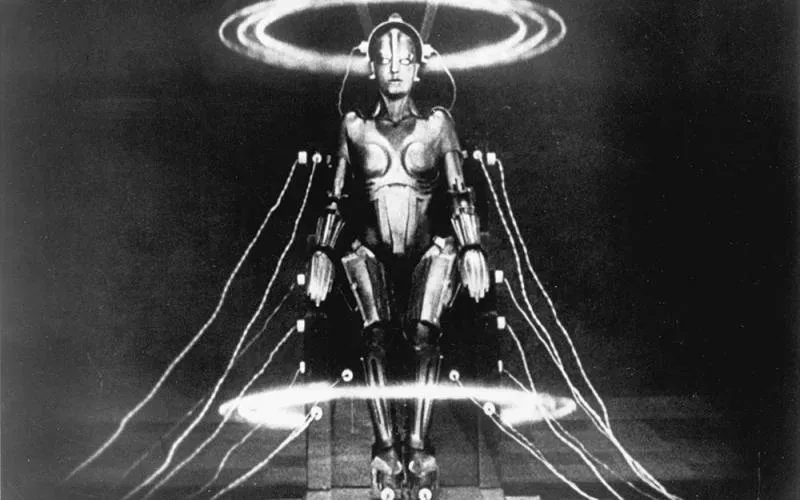 This is the future we practiced for (Image: Metropolis, 1927)
Should we have failed faster?
Maybe.
Not because experimentation is reckless.
But because delayed failure is costly.
Slow failure normalizes harm.
It trains us to tolerate what we should question.
It makes reversal feel unrealistic.
Every major system fails at some point.
The real test is whether we still know how to say this isn’t working before momentum turns into authority.
A quieter ending, with teeth
AI won’t decide whether we move forward or start over.
We already are.
It will simply reveal how willing we were to trade judgment, responsibility, and doubt for speed.
If this experiment fails, it won’t be because the tool was too powerful.
It will be because we kept going long after we felt something important slipping away
and told ourselves that was just progress.